
Randolph County's Current Owner of Record
The Owner(s) field leads the assessment detail. It lists the current tax-roll name. That display is not a promise the roll updated the day a deed was filed. The card keeps mailing, physical and E-911 addresses separate, and adds district, map, parcel, suffix, tax class, book and page, plus a legal description. When timing or vesting matters, follow the book/page reference to the recorded instrument. The deed settles what the card only displays.
| Owner(s) | Name displayed on the current assessment card |
|---|---|
| Mailing Address | Where tax notices are sent |
| Physical / E-911 Address | Land location or emergency address, which may be blank |
| District / Map / Parcel / Suffix | Tax-map identity for the property |
| Book / Page | Recorded reference to check at the County Clerk |
| Tax year and parcel history | Assessment year plus available annual card rows |
One Randolph sample card shows how the fields diverge. The physical location reads Virginia Avenue. Tax mail, though, travels to Randolph Avenue, where both the Owner(s) entry and the mailing destination name the Randolph County Commission, alongside a legal description, tax year 2026 and a book/page reference.
That one card is the lesson. An owner field, a mailing destination and a property's situs are not the same address. The official state assessment detail for the Randolph parcel shows all three.
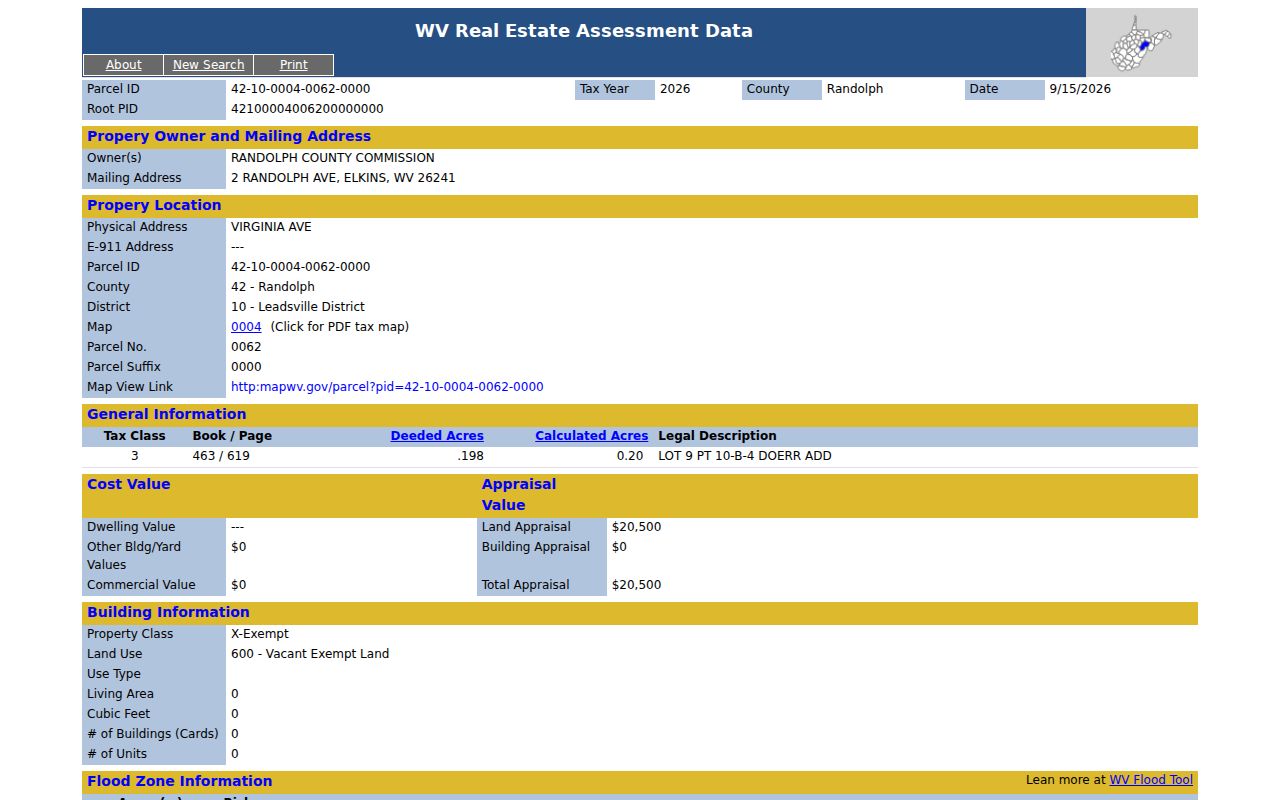
The card shows the tax roll as it stands today. It will not name every co-owner hidden in a search row or settle each legal interest.
Randolph County Mailing and Physical Addresses
The mailing address is a tax-notice destination. The physical address is where the parcel sits. Neither one promises the other matches it. An E-911 address can sit blank, especially where a property is known by road, map segment or legal description rather than a street number. On the sample card, Virginia Avenue is the situs and Randolph Avenue gets the mail. Weigh any match against district and legal description.
Treat the mailing field as a contact clue. It may point to a county office or a second address rather than a home. The Randolph County records do not confirm who occupies a parcel, so the mailing address never proves who lives on the land.
How Current Is the Randolph County Owner Record?
The card shows one tax year at a time. Randolph County publishes no fixed number of days between closing and a roll update, so no local interval can be promised. A deed can be recorded before the tax roll shows the new grantee. That gap is normal. After a recent sale, the latest County Clerk instrument is the timing check, and the Assessor can explain a card that still carries an older name.
Search rows carry another limit. The online record may list a single owner even when several people hold an interest. Open the detailed card. Compare its reference with the recorded deed. A blank or single-name row is never a title report, so treat it as a starting point rather than the final word.
Randolph County Owner History on the Assessment Card
History rows cover tax years 2006 through 2026 on the sample card. A sale-history entry reaches back to 1998. Those rows show what the assessment system displayed over time. They are not a deed chain. The current-owner question turns on the present roll and the newest transfer, so history matters mainly for spotting a mismatch or an older reference.
Save the tax year, parcel ID and book/page. If an older card disagrees with the current owner display, compare the recorded instrument instead of assuming an annual row documents a conveyance.
Book/page 463/619 beats the history rows here. It points straight to the recorded conveyance. The assessment history can prove an owner display changed. It cannot name the parties. The deed explains who transferred the described land and when the instrument was recorded. Keep the latest card and its instrument reference together whenever an owner update is in question.
Randolph County LLC, Trustee and Estate Names
The Owner(s) field is not always a person. An LLC, trustee, executor or estate can hold the spot. The County Clerk's Estates index holds wills and fiduciary bonds. It also lists orders, heir listings, letters of administration, settlements and small-estate filings. A recorded deed or fiduciary order often explains the name on the roll. For an LLC, the West Virginia Secretary of State business search shows organization and agent details. That search proves nothing about this parcel's ownership.
Keep the two roles separate. The current card carries the tax-roll display. The latest deed carries the recorded vesting. When several parties appear, the instrument, not a single owner row, tells the story.
Confirm the Current Randolph County Property Owner
Read the Owner(s) entry as today's assessment display. Then compare the latest recorded deed. Start from the parcel's book/page or search by party name in the County Clerk's index. Confirm the instrument describes the same land. Confirm, too, that no later deed has been recorded, and remember this is a check of the present owner rather than a backward chain.
- Open the West Virginia assessment card and copy Owner(s), tax year, parcel ID and deed book/page.
- Search the County Clerk's index for the newest instrument tied to that party or reference.
- Compare the deed's grantee and legal description with the parcel card.
- Ask the Assessor about an outdated owner display or address field.
- Owner of record
- The party named in the current assessment or recorded instrument.
- Assessment roll
- The tax record that displays parcel, owner and appraisal fields.
- Situs / mailing address
- Land location and notice destination, which can differ.
- Recording lag
- The gap between a deed filing and a tax-card update; Randolph does not publish a typical interval.
The County Clerk index gives you six ways in. Individual, Firm, Book & Page, Instrument, Description, and Date Range are the search modes. Each one fits a different kind of clue. Match the mode to what the current card already shows. If you have a book and page number, the search pulls the exact deed fast. You may only know the buyer's name. You may only know a rough filing window. A firm or date-range search can surface the newer instrument instead. Before you accept the grantee as the current owner of record, read the land description in the deed itself. Confirm it matches this parcel. A name alone is not proof.
Correct a Randolph County Owner-of-Record Entry
Wrong ownership or address on a parcel card? The West Virginia assessment service sends those corrections to the local Assessor. Call the Randolph County Assessor at 304-636-2114 with the full parcel ID. Have the tax year and the book/page reference ready too. The Assessor fixes the tax record. The County Clerk keeps the recorded deed itself.
When the current card and the newest deed disagree, ask each office to check its own record. A deed copy, a legal description and the closing date help staff locate the right entry. No county-specific update deadline applies. So ask about current processing steps rather than assuming a fixed lag.
Use Randolph County Owner Records for Property Questions
A mailing address on an assessment card is public tax record data. For a property-related notice, it may be the right route. But read it carefully. It can point to an office or an entity rather than the parcel's occupant. The assessment search and the Viewer are built around parcels and recorded information, so they will not verify a private residence or explain every arrangement behind a trust or estate.
Lawful use. Use Randolph County owner records for property research and lawful property matters. Never use a public name or mailing address to stalk, threaten, harass or harm another person.