
How to Find Who Owns a Randolph County Property
A street address works well as a starting point. The West Virginia Property Assessment search finds the parcel card. Copy the Owner(s) field, both addresses, district, map, parcel, suffix, legal description, and book/page. Then open the County Clerk's deed index and check the latest recorded instrument. The card is a tax-roll snapshot; the deed supplies the recorded transfer. Entity names call for state business records. Decode the label, then return to that parcel's deed. This builds a traceable record path to the question of who owns this property. It cannot reveal occupants or hidden beneficial owners. Nor does it establish clear title. A blank E-911 field or an away-from-site mailing address is not a red flag on its own.
- Search the address or street name in West Virginia Property Assessment and open the likely Randolph parcel card.
- Copy the displayed Owner(s), book/page and legal description, then locate the matching recorded deed.
- Compare the grantee and legal description on that deed with the assessment card.
- If the deed names an LLC, use the West Virginia Secretary of State entity search for context, not proof of ownership.
Randolph County's Owner(s) Field and Address Clues
The state assessment card labels its owner entry "Owner(s)." "Mailing Address" sits beside it. "Physical Address" is separate. On a Randolph sample card, the physical location sits on Virginia Avenue. Mail goes to the County Commission on Randolph Avenue. That split is ordinary. Tax notices follow a mailing destination, while the parcel stays at its site.
Results can show one owner. Several people may hold interests. The detailed card and latest deed show how the interest is recorded. The state system asks users to contact the local assessor. That applies when ownership or address data is wrong.
The image comes from the WV Assessment detail for a Randolph County parcel.
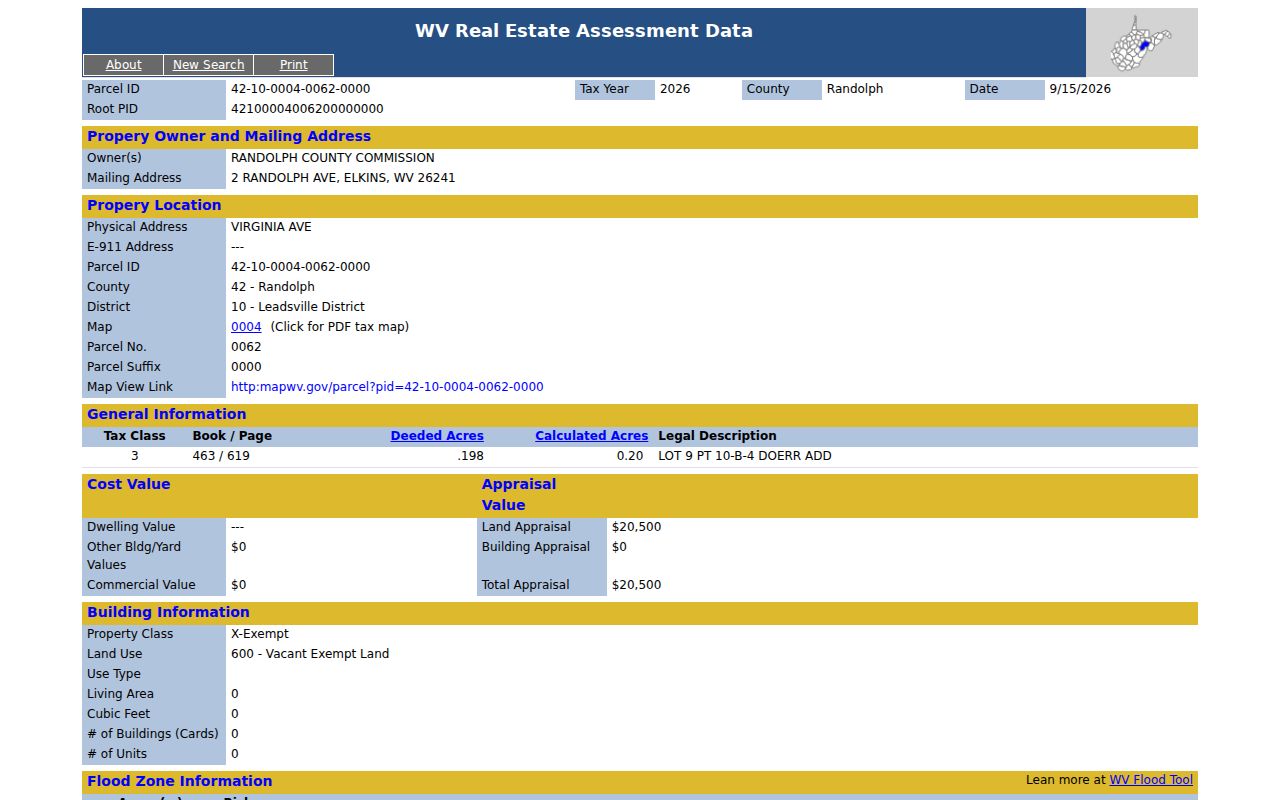
Treat the mailing field as a contact clue only. It may point to an office or post box rather than the land itself.
Where Randolph County Ownership Appears
Three records do different jobs. The Assessor's card names the owner. The Clerk's deed index records the grantee and the land description. The WV Viewer plots parcel geometry and links to assessment detail. For recent or disputed transfers, trust the Clerk's instrument.
The West Virginia Secretary of State can identify a business entity named in a deed. It cannot replace the recorded transfer. It cannot confirm an agent's authority over a parcel.
| Source | Owner Info It Gives | Access |
|---|---|---|
| Assessment card | Displayed owner, parcel and mailing address | Free state search |
| County Clerk index | Recorded grantee and instrument reference | Terminal or remote access |
| Secretary of State | Entity name, agent and organization details | Public business search |
| WV Property Viewer | Parcel location, owner row and physical context | Free statewide map |
An owner of record is the party named in a property record. An occupant is not always that party. Mailing addresses show where tax mail goes. A situs or physical address locates the parcel. "Grantee" labels the deed's receiving party. "Title" is the legal ownership interest, and it may need a full chain review.
The state business search offers organization, agent, officer, and name fields. Advanced filters cover county, organization type, business type, and status. Randolph is an available county choice. The image comes from the West Virginia Secretary of State advanced search.
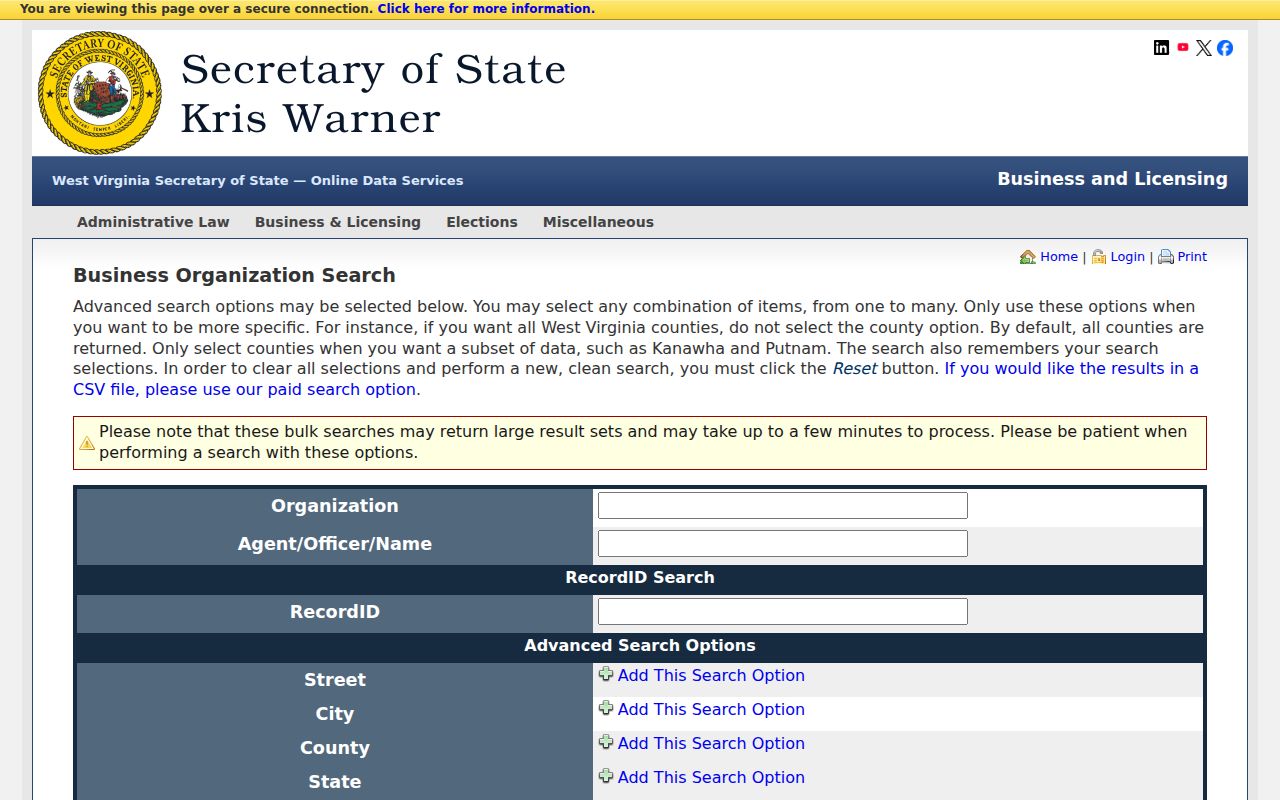
Use the search to decode an entity name. Then confirm the parcel link in the deed and the assessment card.
Confirm a Randolph County Owner After a Recent Sale
Randolph publishes no fixed interval for tax card updates after closing. A deed can record before the card catches up. When timing matters, pull the latest deed from the Clerk's index. Check grantee and legal description against the card. The deed is the more current record. An index row still needs the actual instrument for careful review. Record the instrument number or book/page. Ask the Clerk for a copy if anything is incomplete, and contact the Assessor if the card shows an older name. A parcel-history row alone won't date a transfer.
Randolph County LLC, Trust and Estate Names
Not every Randolph County deed names a living person. Trustees, executors, administrators and LLCs appear there too. That can make a Randolph County property search feel stuck, but the Clerk's office has more to offer. Its Estates group holds appraisements, fiduciary bonds and orders, heir listings, letters of administration, settlements, small-estate filings and wills. Estate files can explain an odd transfer.
The estate index is the starting point. Follow the book/page reference to the full file. LLCs call for a different stop. The Secretary of State returns organization and registered-agent information for them. The advanced form takes organization, agent and name fields. It also accepts a Record ID plus filters for county, organization type, status and effective dates. Randolph is one of the county choices. A basic search allows the percent sign as a wildcard, and fictitious business names can appear in results.
Use an entity result to decode a label on the deed or assessment card, then return to the Clerk instrument to verify the parcel connection. A public record name alone never identifies every person with an interest, and an entity filing is not proof it owns this land.
When Randolph County Owner Records Disagree
Randolph County records sometimes disagree. A card and a deed can disagree. Keep both references handy. The County Clerk answers for recorded instruments; the Assessor answers for the tax-roll owner and the address display. Ownership and address errors are the Assessor's job. The state assessment page says exactly that.
The Sheriff's tax account adds a separate view of payment and delinquency status. Bundle the parcel ID, legal description, deed book/page, document date and tax year so an office can pull the exact record without guessing from a street name. A title company or attorney can review the chain when the difference touches a purchase or legal right.
Randolph County's Virginia Avenue Card Separates Owner Clues
One example card shows how much a single record can hold. Randolph County Commission appears as Owner(s). The mailing address is Randolph Avenue, while the physical location sits on Virginia Avenue. A formatted Parcel ID, 42-10-0004-0062-0000, anchors the entry. The card also cites book/page 463/619 with a Doerr Addition legal description. Each field answers a different question for a Randolph County property search. The owner entry names the party on the tax roll. The mailing field routes notices. The physical address places the parcel on the ground.
Put the parcel number into the Viewer to pull this same card. Then carry the book/page and the legal description to the County Clerk's index. The recorded deed records live there. Searching only the Commission's mailing location is a trap. That address is not the property site. The mapped parcel and the recorded description must agree first. Only then does an address lead to the right owner of record.
Limits of a Randolph County Owner Lookup
A Randolph County owner lookup has firm limits. It shows record entries, not a verified list of occupants or every private arrangement behind an entity. The system can show one owner when several exist. A roll name is not a title search. The deed index alone may miss interests that were never recorded.
Lawful use. Randolph County owner information is for property research, purchase diligence and civic review. Do not use it to stalk, harass, intimidate or harm another person.