
What Randolph County Property Tax Records Contain
Randolph County keeps the assessment and the tax bill separate. The state card carries tax-year and parcel fields, owner and mailing data, the legal description, appraisal components, and parcel history. It also holds parcel history from prior years. The Sheriff publishes payment timing, delinquency, and land-sale information. Start with the assessment card. Identify the parcel there first, then verify any bill or payment with the Tax Office.
| Field | What It Shows | Where |
|---|---|---|
| Tax year and class | Year and assessment category tied to the parcel | WV Property Assessment |
| Land, building and total appraisal | Separate appraisal fields in the tax card | WV Property Assessment |
| Owner, mailing and physical address | Displayed owner and two distinct address fields | WV Property Assessment |
| Tax bill and status | Amount due, payment or delinquency details | Randolph Sheriff Tax Office |
| Land-sale / redemption trail | Published sale links and state redemption records | Sheriff / State Auditor |
The sample card totals $20,500 for 2026. All of it is land. The building appraisal reads $0. Tax class 3 and land-use code 600, "Vacant Exempt Land," appear on the card as well. One parcel says nothing about every Randolph County exemption, and it is not a current market price.
Randolph County Tax Assessment Search Details
West Virginia's Assessment search takes a wide range of inputs. County, district, parcel ID, owner, and street name all work. So do property class, tax class, sub-parcel, and land-use codes. There are also filters for appraisal, acreage, sale date and price, flood hazard, mailing address, deed book and page, legal description, and building details. The legal description and parcel number are the safest identifiers. They are the best way to tell similarly named tracts apart.
Searching through the state assessment application is free. One quirk: the card's Owner(s) field can show a single person in the search row. That can happen even when several owners hold title. Need a corrected owner or address? The state page sends those fixes to the local Assessor.
The Randolph County parcel detail page displays tax-year, class, value, acreage, and sale-history fields. Those fields all describe a single property.
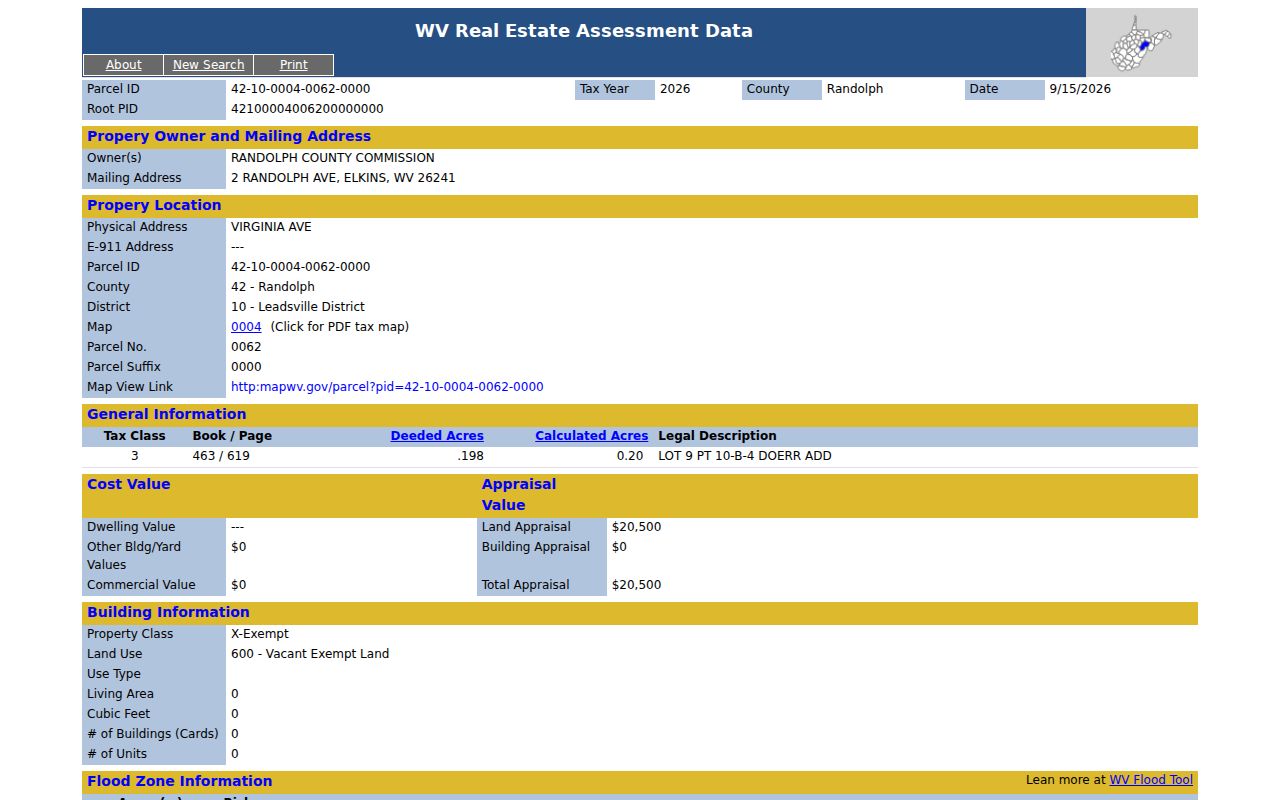
These fields explain how the tax roll gets its numbers. The Sheriff's account remains the authority on whether a specific bill is paid or delinquent.
Looking Up a Randolph County Tax Bill
Randolph County tax bills start with the parcel or account details shown on the assessment card, so have those handy before you call. The Sheriff's site posts links to real-estate tax material and the county tax-payment gateway, though it offers no live tax search field. For a lookup by parcel number or owner of record, contact the Tax Office directly at 4 Randolph Avenue, Suite 100, Elkins, WV 26241, or call 304-636-2100.
- Use West Virginia Property Assessment to identify the parcel and save the owner and legal description.
- Open the Sheriff's real-estate tax page and follow its official payment or tax-record links.
- Check the current bill and prior payment status with the Tax Office if the online result is unclear.
- For a tax-sale or redemption question, confirm the parcel's status with the Sheriff and State Auditor.
- Assessed/appraised value
- The amount shown on the assessment card for tax purposes.
- Tax delinquency
- An unpaid account that has passed the published payment milestone.
- Redemption
- The post-sale process handled through the State Auditor; verify the parcel deadline.
- Deeded acreage
- Acreage stated in the land record and distinct from a GIS calculation.
Randolph County's Real Estate Tax Calendar
Bills are mailed and payable by July 15. August 31 is the last day before certified-letter or publication costs get added, and the first-half discount ends September 1. October 1 is the first-half delinquency date. The second-half discount runs through March 1, and that half turns delinquent on April 1. Accounts still unpaid after April 30 may face publication and extra fees, with the annual land sale following in October.
This is the countywide schedule only. It cannot say who paid or what sold. The Sheriff posts current notices. The State Auditor handles redemption after a sale and keeps the delinquent and nonentered land records.
See the Randolph County tax calendar from the Sheriff's Office. Every milestone sits in one view.
A tax-sale parcel needs two checks. Read the county notice. Read the State Auditor file as well. West Virginia's Property Viewer describes an 18-month redemption window before a tax-sale parcel reaches the auction block. Treat that as a general lead. The State Auditor confirms the actual sale date and redemption deadline. Its delinquent, nonentered, and redeemed-land records answer a different question than the Sheriff's current tax account, so keep the sale year and parcel number with any inquiry.
Randolph County Tax Maps and Parcel Cards
The Sheriff's tax-map page gathers tax maps, map cards, payment links, and public-record links in one spot. The card's map number points to the right PDF. The sample parcel links to Map 0004. Match the map identifier against the parcel ID and legal description rather than trusting a street name alone.
A tax map orients a parcel among its neighbors. It does not establish a surveyed line. The state Viewer keeps deeded acreage and calculated GIS acreage separate, and it labels the calculated figure an estimate. The sample card shows the gap: 0.198 deeded acres against 0.20 calculated. Small gap, real distinction.
The Sheriff's Randolph tax-map page rounds out the set. Use its map links as a route back to the assessment record and the Clerk's recorded description.
Value or acreage can drive a tax appeal. Ask the Assessor how the card's deeded acreage and appraisal were applied to the specific parcel.
How to Check a Randolph County Tax Bill
A parcel number is the best starting point. It stays stable even when a mailing address changes. It also holds when the owner of record does not. If you only know the street, open the assessment site first and find the parcel card. Then follow the official Sheriff links from there for payment status and tax bill details. Randolph County publishes no live bill form with its required fields. So the account is not always clear from the screen. When in doubt, confirm the details with the Tax Office directly.
- Find the Randolph parcel in the state assessment system and save its district, map and parcel ID.
- Use the Sheriff's official real-estate tax links or call the Tax Office for the account status.
- Compare the tax year and parcel details before matching a payment to a card.
- If delinquency or a land sale appears, ask about the next step and confirm redemption with the State Auditor.
- Assessed/appraised value
- The value fields shown on the card; this research did not verify a separate Randolph ratio.
- Tax bill
- The Sheriff's account showing amounts due and payment status.
- Tax lien
- A recorded or tax-account claim that must be checked with its custodian.
- Tax sale
- The county's annual land-sale process for eligible delinquent property.
Randolph County Tax Class Is Not an Exemption Guide
One assessment card shows Tax Class 3 with a Land Use value of 600, labeled "Vacant Exempt Land." That tells you where classification appears on a Randolph County parcel card. It proves nothing about an exemption rule, though. Nor does it establish a personal eligibility category or any general property-tax reduction. The county publishes no current Randolph exemption list or application schedule. So treat the number as a label, not a benefit. Ask the Assessor to explain the exact classification on your parcel card.
The Assessor's published phone is 304-636-2114. The state property search itself notes that local offices should resolve incorrect details. Those include an incorrect owner, address, or other assessment information. Keep a copy of the card when you call. Identify the tax year in question, since the search can display parcel history across multiple years.
Questioning a Randolph County Assessment
Start with the card itself. Check the parcel ID, tax year, and legal description. Then look at the land and building fields, the acreage, and any sale-history row. If a value or ownership field looks wrong, contact the local Assessor. Ask which review process applies to the current assessment year. Randolph County publishes no confirmed appeal deadline, review-board calendar, required evidence list, or appeal form. Never assume a date from a neighboring county or an old cycle.
For a value question, explain the disputed field. Give the supporting parcel or deed reference. A recorded sale, a site plan, or a current property description may help the office understand your concern. Keep in mind that the tax card itself does not establish market value. For a tax-bill amount or a payment problem, the Sheriff is the county contact. The Assessor maintains the assessment record.
Keep the card or notice handy. Note the date you contacted the office. Ask which deadline applies to the current assessment year. Ask whether a form or supporting record is required; the published sources do not answer those local procedure questions. Keep a tax-payment dispute separate from an appraisal question. The Sheriff and the Assessor maintain different parts of the property record.
Confirm the current window. Randolph County's current appeal deadline and review steps were not verified in the available official sources. Contact the Assessor promptly for the active cycle, required form and filing date before relying on an older notice.